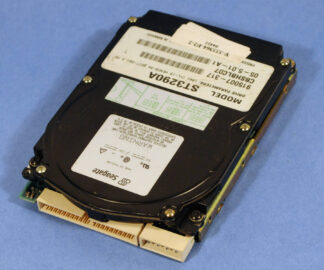
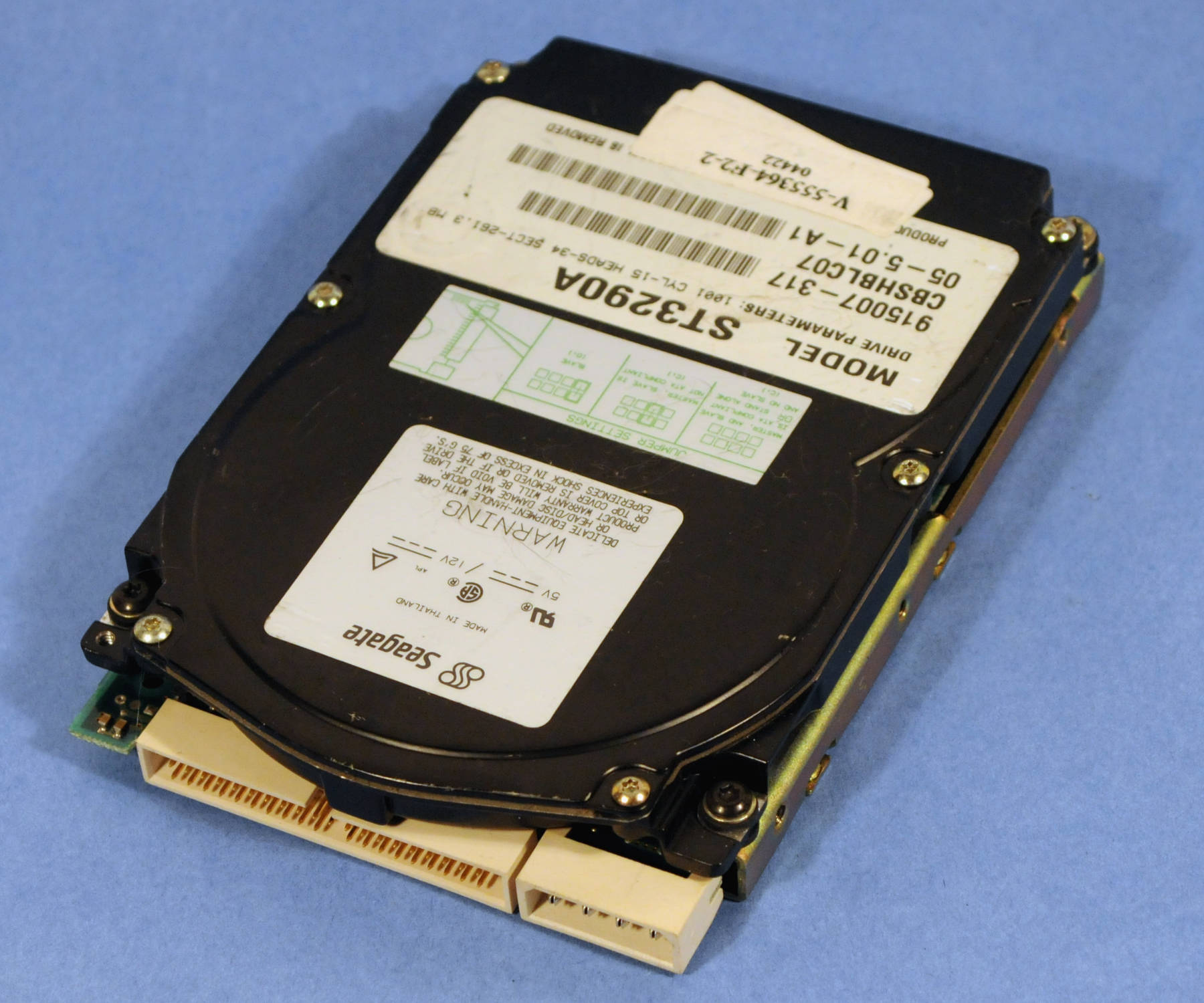
IDE Hard Drive Seagate ST3290A 260MB
$24.95
1 in stock
Description
The Seagate ST3290A is a vintage 261 MB (often rounded to 260 MB) IDE (PATA) 3.5-inch IDE hard drive from the early 1990s (released around 1992–1993). It belongs to Seagate’s early ATA/IDE family, commonly used in 386/486-era PCs and early Pentium systems as a boot or secondary storage drive.
*** Hard drive is tested for good S.M.A.R.T. , no bad sectors and is formatted as a Fat 32 partition.
Key Specifications
- Capacity: 261 MB (formatted; unformatted/raw ~290 MB)
- Interface: IDE / ATA-1 (early Parallel ATA, 40-pin connector)
- Form Factor: 3.5-inch slimline/low-profile (standard 3.5″ bay compatible, dimensions approx. 101.6 mm × 26.1 mm height)
- Rotation Speed (Spindle Speed): 3811 RPM (unusual non-standard speed for the era, slower than typical 3600 or 5400 RPM drives)
- Cache/Buffer: 64 KB (segmented)
- Geometry (Cylinders / Heads / Sectors): 1001 / 15 / 34 (translated; native may differ slightly due to translation for IDE BIOS limits)
- Platter Count: 2
- Seek Times:
- Average/Random seek: ~16 ms
- Track-to-track seek: ~4.4–5 ms
- Data Transfer Rate:
- Internal: ~2.5 MB/s
- External (burst): Up to ~6 MB/s (PIO mode, typical for ATA-1)
- Recording Method: RLL 1/7
- Power Connector: Standard 4-pin Molex
- Power Consumption: Idle ~2.5 W, seek/read/write ~4–4.6 W, standby ~1.3 W
- Operating Temperature: 5°C to 55°C
- MTBF (Mean Time Between Failures): ~250,000 hours (manufacturer rating)
- Warranty (original): 24 months
- Other Features: Lift/lock/parking heads (YES), ECC support, no onboard jumper details universally documented but standard Master/Slave/Cable Select configuration via jumpers on the drive PCB
This drive predates faster ATA modes (e.g., ATA-2/UDMA), so it tops out at basic PIO transfers—very slow by any modern standard (real-world throughput often under 3–4 MB/s). It’s a classic “budget” or mainstream drive from Seagate’s early 1990s lineup, similar in era and performance to models like the ST351A-X or Conner/Maxtor contemporaries.